

- Banned
- #76
Those Aussie race trucks that launch off ramps on a road course are pretty cool. I saw one of those races a couple months back. It looked a lot more exciting than Nascar.
Sponsored
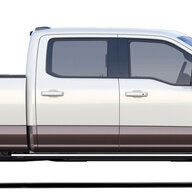




Interesting article.So, I must admit, I've been pretty stubborn (maybe ignorant?) on the whole octane issue. I live at 7000ft and just kind of told myself that 87 octane is fine for my 2023 PowerBoost... but it does indeed appear that 91 octane ($0.60 more per gal) really does provide better performance. The gas has the same energy density, but because of the higher octane the engine controller can be more aggressive on timing providing more horsepower.
Since I don't roll that many miles per year... I think I'll just switch over to 91 octane for a while.
Good article here: https://www.caranddriver.com/features/a28565486/honda-cr-v-vs-bmw-m5-ford-f-150-dodge-charger/

Besides the benefits of 93 vs 87 in our 3.5 Twin Turbos, the computer literally provides better tuning when it detects octane level. So you *will* get a benefit. Whether or not you notice it may be a different story, but for me personally I can definitely notices a difference.So, I must admit, I've been pretty stubborn (maybe ignorant?) on the whole octane issue. I live at 7000ft and just kind of told myself that 87 octane is fine for my 2023 PowerBoost... but it does indeed appear that 91 octane ($0.60 more per gal) really does provide better performance. The gas has the same energy density, but because of the higher octane the engine controller can be more aggressive on timing providing more horsepower.
Since I don't roll that many miles per year... I think I'll just switch over to 91 octane for a while.
Good article here: https://www.caranddriver.com/features/a28565486/honda-cr-v-vs-bmw-m5-ford-f-150-dodge-charger/

There was a problem with detonation with direct injection engines and a team headed up by oak ridge national laboratory --- it was determined part of the cause was the fuel mixing with the engine oil on the cylinder bore being set off by the piston rings interacting with fuel and oil mix at the cylinder wall on the compression stroke. Lake Speed Jr was on that team. After the research was published, new formulations / standards began development. Interesting topic to listen about regarding the LSPI (low speed pre ignition).The higher the compression ratio of a gas engine the more likely there is to be pre-ignition of the fuel when it is injected into the hot cylinders. The 35L engines have a compression ratio that is engineered for 87 octane rated gasoline. Ford recommends using 93 octane when towing to minimize pre-ignition when the engine is working harder to deal with the greater overall load and generating more heat (which is why for towing a larger capacity radiator is needed).


$22 a tank for an extra 20hp on a truck that you pretty much just use as a DD?Since I don't roll that many miles per year... I think I'll just switch over to 91 octane for a while.
So you’re saying today’s problems is because they started putting lead back in gasoline?Once lead was removed from gasoline there was a gradual reduction in crime with fewer brain damaged children becoming adults.
This is not true. We have variable cam timing and overhead cams, more valves per cylinder, exotic alloys in heads and engine blocks, catalytic converters, lead free fuel and ethanol in all pump gas, direct injection, O2 sensors, knock sensors, ethanol sensors, MUCH MUCH more efficient turbos, synthetic oil, higher compression ratios, many more gears in transmissions, higher speed limits etc.As a teenage I bought and read Colin Campbell's book "The Sports Car: Its Design and Performance" and although it was first published in 1954 it is still quite informative. Today's cars have computer controlled fuel injection and electronic spark control but are otherwise unchanged over the past 100 years.
I agree…..Calson is just a WEE bit behind. Engines have advanced DRASTICALLYThis is not true. We have variable cam timing and overhead cams, more valves per cylinder, exotic alloys in heads and engine blocks, catalytic converters, lead free fuel and ethanol in all pump gas, direct injection, O2 sensors, knock sensors, ethanol sensors, MUCH MUCH more efficient turbos, synthetic oil, higher compression ratios, many more gears in transmissions, higher speed limits etc.


