
Sponsored

don_wagner57
New member
F150 powerboost has essentially NO PAYLOAD capacity or battery only operation. Dodge hybrid has approx 2600 pounds and tows 14,000 pounds. I want a hybrid and need a payload of over 2600 pounds of payload. I heard the CEO of Ford saying they were still having quality issues. Otherwise I've been studying on buying the F150 Powerboost.I enjoy watching these guys, although their videos can be a bit repetitive at times.
Anyway... I think that Chrysler has lost their collective minds on this one... if it's true!
https://www.facebook.com/reel/1003387744871298
If you don't want to watch the video, apparently, RAM is putting a gas engine in the XR ... strictly to CHARGE THE BATTERY WHILE YOU ARE DRIVING!
Last edited:

FaaWrenchBndr
Well-known member
- First Name
- Greg
- Joined
- Jun 23, 2024
- Threads
- 13
- Messages
- 2,552
- Reaction score
- 2,555
- Location
- Denver, IN
- Vehicles
- ‘24 XLT Powerboost
- Occupation
- Semi retired aircraft mechanic
I would drive a Volkswagen before I drove a DodgeF150 powerboost has NO PAYLOAD capacity. Dodge hybrid has approx 2250 pounds and tows 14,000 pounds. I want a hybrid and need a payload of over 2000 pounds of payload.

Samson16
Well-known member
- First Name
- Kyle
- Joined
- Mar 24, 2023
- Threads
- 18
- Messages
- 3,622
- Reaction score
- 3,587
- Location
- Orlando, FL.
- Vehicles
- '22 F-150 XLT Powerboost Super Crew 4x4
- Occupation
- Aviation systems
Payload number is gimped.
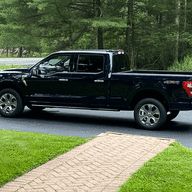
My 2ND Ford
Well-known member
I have had both. While the Ram's [97] build quality wasn't bad, the Volkswagen [74]was downright horrible. My best friends son has a 2016 GTI that has been bulletproof.I would drive a Volkswagen before I drove a Dodge
Sponsored
Samson16
Well-known member
- First Name
- Kyle
- Joined
- Mar 24, 2023
- Threads
- 18
- Messages
- 3,622
- Reaction score
- 3,587
- Location
- Orlando, FL.
- Vehicles
- '22 F-150 XLT Powerboost Super Crew 4x4
- Occupation
- Aviation systems
The Dodge RamCharger doesn’t exist, so for all we know it runs on rainbow dust and can haul 2600 tons of Care Bear dreams.Dodge hybrid has approx 2600 pounds and tows 14,000 pounds. I want a hybrid and need a payload of over 2600 pounds of payload
Fox146
Well-known member
I still think if we’re going that way then plug in hybrid is the way to go. North America is too big to try and get places on battery alone. If I can drive around town on battery and then hit the open road with a gas backup and not worry about range??
scott011422
Well-known member
I personally think that in the truck market, The RamCharger is the absolute best way to go, Best of both worlds. You'll need a pretty earth shattering breakthrough to make towing work with an EV. The batteries and charging just isn't there. By a lot.
But the RamCharger? Really is perfect at this point with what's available. I can drive it like a responsible EV owner with plug in charging 90+% of the time. But if I'm towing or taking a long trip I don't have to have any range anxiety. The built in generator has me covered.
Now you know people are just going use the generator and not deal with plugging it in to charge it. But then why buy it? Totally defeats the purpose.
Dislikes?
1) Wish it wasn't Dodge. But i'm sure we will see this approach adopted by lots of manufacturers.
2) Why limit output for running your house at 30 amps? I know they are not going to give you all 600+ amps that generator is making, But 30?!?! Come on!
But the RamCharger? Really is perfect at this point with what's available. I can drive it like a responsible EV owner with plug in charging 90+% of the time. But if I'm towing or taking a long trip I don't have to have any range anxiety. The built in generator has me covered.
Now you know people are just going use the generator and not deal with plugging it in to charge it. But then why buy it? Totally defeats the purpose.
Dislikes?
1) Wish it wasn't Dodge. But i'm sure we will see this approach adopted by lots of manufacturers.
2) Why limit output for running your house at 30 amps? I know they are not going to give you all 600+ amps that generator is making, But 30?!?! Come on!

HammaMan
Well-known member
'Dodge' is on the wrong track. They're firing loads of employees after having pissed off their customers deleting the V8 from 1/2 tons and cars. All of the mopar fans are pretty much former fans at this point. The ramcharger as a concept is the right approach on paper. The vehicle itself doesn't yet exist and given just how bad their other 2025s are doing including a stop-sale order on their EVs -- well smack yourself with a 2x4 for a cheaper headache.
I look forward to seeing what trends it can set if it does ever come to market, but all indicators thus far are warning to stay far away. Only time will tell. Also be watching for the 250 so called hybrids.
I look forward to seeing what trends it can set if it does ever come to market, but all indicators thus far are warning to stay far away. Only time will tell. Also be watching for the 250 so called hybrids.
Samson16
Well-known member
- First Name
- Kyle
- Joined
- Mar 24, 2023
- Threads
- 18
- Messages
- 3,622
- Reaction score
- 3,587
- Location
- Orlando, FL.
- Vehicles
- '22 F-150 XLT Powerboost Super Crew 4x4
- Occupation
- Aviation systems
Let’s take a closer look at the Ram 1500 Big Horn 4x4 with the 3.6l V6. Curb weight approx. 5100lbs. Range with 26g tank approx. 620 miles.
The V6 struggles mightily just to move 5000lbs adequately. I fail to see the magic between the output shaft of the engine and the rubber of the tires that will enable it to move +7000lbs at anything beyond a snails’ pace. Having to accelerate the RamCharger while charging the HVB? Just no.
I think SOC management will be essential to the success of the RC and I hope it doesn’t get CR’d with bad reviews by people who didn’t do their research properly before purchasing. I’m excited to add charging layovers (plugin or generator) if the benefits outweigh the inconvenience. It might not be for everyone, but it just might be the cats’ meow for some of us!
The V6 struggles mightily just to move 5000lbs adequately. I fail to see the magic between the output shaft of the engine and the rubber of the tires that will enable it to move +7000lbs at anything beyond a snails’ pace. Having to accelerate the RamCharger while charging the HVB? Just no.
I think SOC management will be essential to the success of the RC and I hope it doesn’t get CR’d with bad reviews by people who didn’t do their research properly before purchasing. I’m excited to add charging layovers (plugin or generator) if the benefits outweigh the inconvenience. It might not be for everyone, but it just might be the cats’ meow for some of us!
Sponsored
HammaMan
Well-known member
I've done the math around here somewhere and it clearly checks out 100%. You're missing the battery in this. Tesla semi trucks are averaging about 1.5kWh/mile including fully loaded at 80klbs. If you read the details on the ramcharger the ICE must be running to reach its full rated power meaning they're maxing the C rate on the battery as well as diverting full ICE power to the electric motors. Acceleration is brief - yes, going up a steep hill will be eating some power, but at the same time it gains most of it back going back downhill.The V6 struggles mightily just to move 5000lbs adequately. I fail to see the magic between the output shaft of the engine and the rubber of the tires that will enable it to move +7000lbs at anything beyond a snails’ pace. Having to accelerate the RamCharger while charging the HVB? Just no.
At 70mph most EV pickups are averaging 2 miles / kWh which comes out to 35kWh to go 70 miles in one hour. Best case given other power conversion losses expect the ramcharger running in continual mode to approach an MPG equivalent to an any other ICE truck. Under heavy loading at times like towing full out at highway speeds up hill, yes, the battery will be consumed with the ICE running. That's edgecase though -- the 130kW power output of its "range extender" is enough to keep a fully loaded semi at speed on the interstate.
JExpedition07
Well-known member
- First Name
- James
- Joined
- Feb 14, 2023
- Threads
- 68
- Messages
- 2,126
- Reaction score
- 3,664
- Location
- Buffalo NY
- Vehicles
- 2023 F-150 STX 5.0L V8
5.4L 2V made for a good generator motor back in the day, idk if the V6 will have enough balls…too small of an engine at peak load.
Samson16
Well-known member
- First Name
- Kyle
- Joined
- Mar 24, 2023
- Threads
- 18
- Messages
- 3,622
- Reaction score
- 3,587
- Location
- Orlando, FL.
- Vehicles
- '22 F-150 XLT Powerboost Super Crew 4x4
- Occupation
- Aviation systems
I’m trying to say I fear the RC will need to be charged just like the Lightning. It will just go a bit farther but will then need both a charge and gas. Approx. 1.43kWhr per mile towing 7000lbs over flat ground. We’re still going to need combination fuel/charging stations and they need to be pull through. We’re not unhooking to charge. I’m grinding worse case because that’s where the victory lives.You're missing the battery in this
HammaMan
Well-known member
The ramcharger is by all means an EV. It should be used like an EV. It's got a relatively small battery as an EV (comparatively), but that's where its blend of EV -> PHEV comes into play. PHEVs are typically poor EVs in that they've got a complete lack of the EV punch and rely heavily on the ICE. There's a couple niche examples where the range extender is a joke so the waters are a bit muddy, typically econo-shitboxes, and no the BMW name doesn't elevate it above that status. If I had to draw a line I'd say anything 0-60 sub 7 seconds is okay, and the further north that time goes the poorer the vehicle.
The ramcharger is a radical shift in power-adding capabilities. Even in your 1.43kWhr/mile, with 130kW generation, that's still charging the battery at 30kW. That may seem small, but 30kW cannot be achieved on a home charger (most EVs charge at 10.x kW, the big boys have 19.x kW onboard chargers). That's still DC fast charging levels of power equal to 125 amps of 240v power. That's enough to power a few homes going back into the battery, while towing.
The ramcharger is a radical shift in power-adding capabilities. Even in your 1.43kWhr/mile, with 130kW generation, that's still charging the battery at 30kW. That may seem small, but 30kW cannot be achieved on a home charger (most EVs charge at 10.x kW, the big boys have 19.x kW onboard chargers). That's still DC fast charging levels of power equal to 125 amps of 240v power. That's enough to power a few homes going back into the battery, while towing.
amschind
Well-known member
I think that the OP didn't really grasp the concept at first, but he and others did accurately describe the problem with bootstrapping this technology. It's not an issue with understanding so much as an issue with pushing past the initial technological resistance.
When you pair a spark 4 stroke V6 from the regular truck with a generator, most folks reasonably ask "Why?". In the first generation, there isn't a good answer: the gains are marginal, and it is tough to find a place where it does something better than a regular truck or a BEV. It combines some of the nice features of both, but doesn't beat either one at its own game.
The real utility of a series hybrid shows up with purpose built prime movers. The thing that killed the 2 stroke wasn't emissions, but the EXTREMELY narrow power band. Bows were more fearsome weapons than firearms until the 1860s, BUT only if used by highly trained archers. If you just levied the peasants and handed them a weapon, the peasants with muskets would wipe the floor the the peasants armed with longbows. The old -71 diesels can wear DPF and EGR and SCR just like any other diesel, but the 400 RPM power band requires an attentive driver who knows what they're doing and is willing to watch RPM and EGT closely for long periods of time. 30 minutes on an interstate is enough to convince anyone that most truck drivers today cannot handle keeping it between the lines, much less active management of the powertrain.
We are in the same intermediate stage with 2 strokes: they are technologically more advanced that 4 strokes, BUT require either highly skilled operators OR technological advancement that obviates that need in order to outperform 4 strokes. HCCI is kind of in the same boat, as it is difficult to get right even under steady state conditions, and really struggles when load and RPM are all over the place. Mazda added a spark plug to make sure that it goes boom when they cannot get the compression ignition to work reliably. Those technologies are not mutually exclusive, and actually dovetail very nicely. The opposed piston designs occupy a similar niche: lots of parts and parasitic losses can vanish IF your engine only needs to run at a very narrow RPM.
Taken together, I think that's the intermediate path forward: if we can get over the hump of "why is there a mini-van engine in my BEV?" phase, the next generation of engines really shines. As I have said many times, a Deltic or flat opposed piston HCCI powerplant a steam or scCO2 bottoming cycle is basically the adaptation of known working technology. There is plenty of engineering work to be done, but all of those pieces are high reliability items and have been for close to a century. The old Fairbanks-Morse 38-8-1/8D opposed piston engines were the backups power on nuclear submarines until the Virginias (and they were only changed then because they are bulky).
Beyond that, batteries are going to fall A LOT in price, but the energy density will improve maybe 10% beyond where we are today with LiFePO4. Sodium anode free batteries are coming faster than anyone recognizes because they are as energy dense as current battery tech but far cheaper. Lithium anode free is going to get reserved for small devices and luxury vehicles. The Tesla S might have an anode free Lithium battery, but the Y and 3 will have sodium. I think that methane winds up picking up the slack. In the 20-50 year time frame, direct carbon fuel cells with thermoelectric bottoming cycles have the potential to push 70% efficiency while using just a fan, an oil pump and coolant pump for the battery and traction motors. A truck that gets 45 MPG equivalent and has a 2000+ mile range with better than Lightning torque figures is more or less an end point: physics starts to interfere with major improvements.
Right now, series hybrids are the start of that whole process because it is the public and automakers discovering that the traction motors are electron agnostic: they don't care if a mini-van engine, an advanced rehash of an old piston design, a mini combined cycle power plant, a lead acid battery, an anode free lithium battery, a crank generator powered by team of coked-up gerbils, a fusion reactor or some other crazy tech provided said electrons. That's why this matters: it isn't where it is, it's where it's going.
When you pair a spark 4 stroke V6 from the regular truck with a generator, most folks reasonably ask "Why?". In the first generation, there isn't a good answer: the gains are marginal, and it is tough to find a place where it does something better than a regular truck or a BEV. It combines some of the nice features of both, but doesn't beat either one at its own game.
The real utility of a series hybrid shows up with purpose built prime movers. The thing that killed the 2 stroke wasn't emissions, but the EXTREMELY narrow power band. Bows were more fearsome weapons than firearms until the 1860s, BUT only if used by highly trained archers. If you just levied the peasants and handed them a weapon, the peasants with muskets would wipe the floor the the peasants armed with longbows. The old -71 diesels can wear DPF and EGR and SCR just like any other diesel, but the 400 RPM power band requires an attentive driver who knows what they're doing and is willing to watch RPM and EGT closely for long periods of time. 30 minutes on an interstate is enough to convince anyone that most truck drivers today cannot handle keeping it between the lines, much less active management of the powertrain.
We are in the same intermediate stage with 2 strokes: they are technologically more advanced that 4 strokes, BUT require either highly skilled operators OR technological advancement that obviates that need in order to outperform 4 strokes. HCCI is kind of in the same boat, as it is difficult to get right even under steady state conditions, and really struggles when load and RPM are all over the place. Mazda added a spark plug to make sure that it goes boom when they cannot get the compression ignition to work reliably. Those technologies are not mutually exclusive, and actually dovetail very nicely. The opposed piston designs occupy a similar niche: lots of parts and parasitic losses can vanish IF your engine only needs to run at a very narrow RPM.
Taken together, I think that's the intermediate path forward: if we can get over the hump of "why is there a mini-van engine in my BEV?" phase, the next generation of engines really shines. As I have said many times, a Deltic or flat opposed piston HCCI powerplant a steam or scCO2 bottoming cycle is basically the adaptation of known working technology. There is plenty of engineering work to be done, but all of those pieces are high reliability items and have been for close to a century. The old Fairbanks-Morse 38-8-1/8D opposed piston engines were the backups power on nuclear submarines until the Virginias (and they were only changed then because they are bulky).
Beyond that, batteries are going to fall A LOT in price, but the energy density will improve maybe 10% beyond where we are today with LiFePO4. Sodium anode free batteries are coming faster than anyone recognizes because they are as energy dense as current battery tech but far cheaper. Lithium anode free is going to get reserved for small devices and luxury vehicles. The Tesla S might have an anode free Lithium battery, but the Y and 3 will have sodium. I think that methane winds up picking up the slack. In the 20-50 year time frame, direct carbon fuel cells with thermoelectric bottoming cycles have the potential to push 70% efficiency while using just a fan, an oil pump and coolant pump for the battery and traction motors. A truck that gets 45 MPG equivalent and has a 2000+ mile range with better than Lightning torque figures is more or less an end point: physics starts to interfere with major improvements.
Right now, series hybrids are the start of that whole process because it is the public and automakers discovering that the traction motors are electron agnostic: they don't care if a mini-van engine, an advanced rehash of an old piston design, a mini combined cycle power plant, a lead acid battery, an anode free lithium battery, a crank generator powered by team of coked-up gerbils, a fusion reactor or some other crazy tech provided said electrons. That's why this matters: it isn't where it is, it's where it's going.
Sponsored
Similar threads


- Replies
- 31
- Views
- 4,789

